
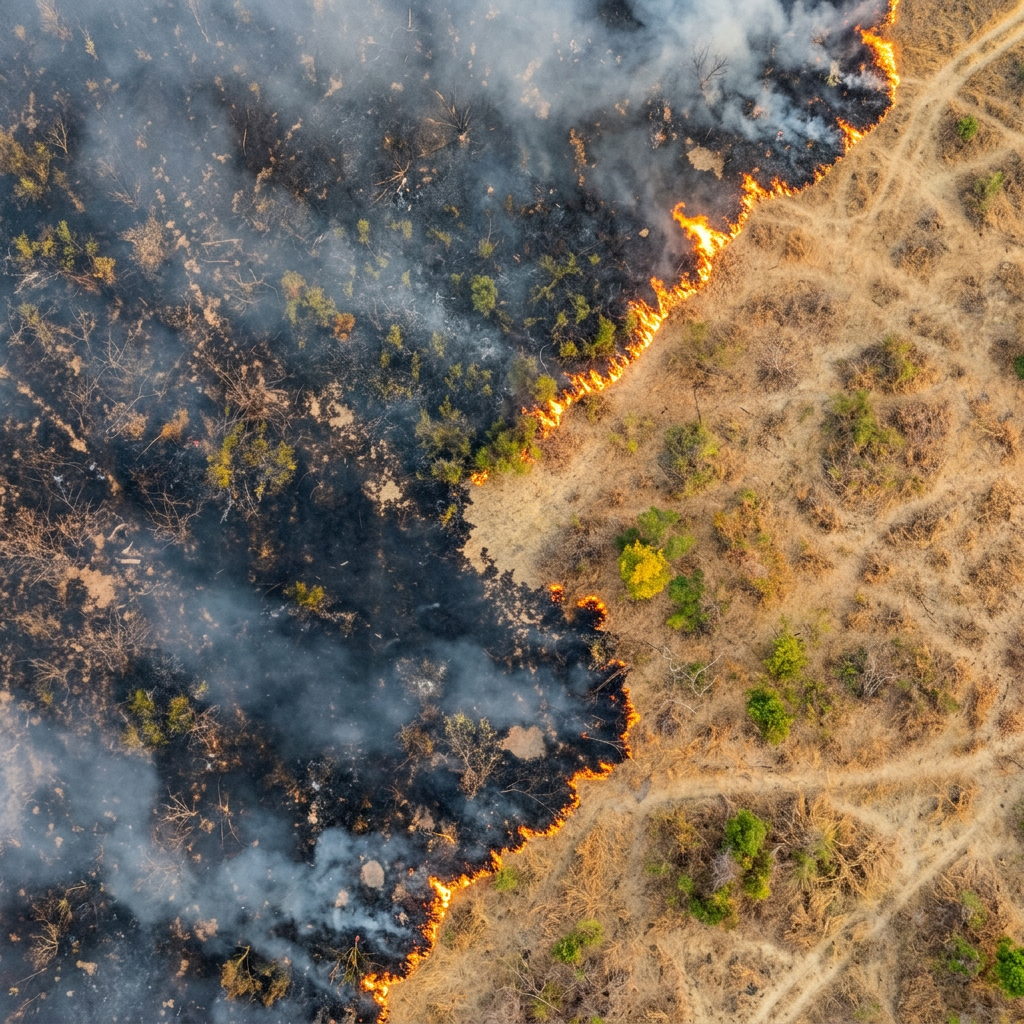
Two Continents, One Fire Season.
Three countries. Three fire regimes. One unmistakable signal — the seasons no longer behave the way they used to, and the homes inside them are no longer protected by the assumptions that used to keep them safe.

By the second week of May 2026, more than 2.4 million hectares had already burned across the Canadian boreal. In the western United States, dry-lightning complexes were running in California, Oregon, and Washington a full six weeks ahead of the long-term average. And in Australia, an unusually warm autumn was being recorded as the driest in 78 years of continuous observation — setting up a southern-hemisphere fire season that the Bureau of Meteorology now describes as "front-loaded into spring."
The fire seasons are no longer behaving like fire seasons used to behave.
By the Numbers — Mid-May 2026
Three continents. One identical signal.


Boreal returning to elevated activity after two contained years.
Below-average hectare count masks accelerating ignition timing.
Front-loaded southern-hemisphere season after three La Niña years.
of homes lost in interface wildfires are ignited by embers — not direct flame contact.
wind-driven embers travel ahead of the visible fire front.
typical evacuation window — far longer than any garden hose or temporary sprinkler can cover.
The Numbers That Don't Add Up — Until They Do
Look at the headline statistics from the first half of 2026 and the picture seems contradictory. The United States is on track for an average-to-below-average total hectare count for the year. Canada, after the catastrophic 2023 season, has had two relatively contained years and now appears to be returning to elevated activity. Australia's eastern states had three wet La Niña summers in succession — and yet 2025–26 has already produced significant losses across the Adelaide Hills, the Grampians, and Western Australia's south coast.
Total hectares burned is the wrong metric to measure what is happening to homes. The right metric is structures lost per hectare burned, and on that measurement every single one of the last six fire seasons across North America and Australia has set a record. More houses are being destroyed by fewer fires. Wildland-urban interface losses are no longer correlated to the size of the season — they are correlated to where the fires land. And the fires keep landing where the houses are.
What Actually Changed Between the Old Fire Seasons and the New Ones
Three things changed, and they changed together. First, fuel moisture deficits became chronic instead of seasonal. Continuous global temperature records mean the forest, the grassland, and the eucalypt canopy enter each fire season already a step closer to ignition. The same lightning strike, the same downed powerline, the same discarded cigarette now starts a fire that runs harder and farther than it would have done in 1995, 2005, or even 2015.
Second, the wildland-urban interface expanded. Across every developed country, post-pandemic migration into mountain, forest, and coastal communities pushed homes into landscapes that fire crews used to fight without houses in the way.
Third — and this is the one that matters most for protection strategy — ember production per fire intensified. Hotter fires throw more embers, farther, and for longer. A modern crown fire is not just a bigger version of an older crown fire. It is a different physical event.
Total hectares burned is the wrong metric. The right metric is structures lost per hectare — and on that measurement every fire season for the last six years has set a record.Compiled from NIFC, CIFFC, and AFAC reporting, 2020–2026
Why Defensible Space Is Necessary — and No Longer Enough
Every homeowner in a fire-prone landscape has been told, correctly, to clear vegetation within 10 metres of the structure, to upgrade to Class A roofing, to box in eaves, to install ember-rated vents, and to maintain a 30-metre fuel-reduced zone where possible. This guidance — FireSmart in Canada, Firewise USA in the United States, the AS 3959 BAL standard in Australia — represents decades of post-fire forensic research and it is unambiguously correct. Homes built and maintained to current standards survive wildfire dramatically more often than homes that aren't.
But survival rates measured against a 2005 fire regime do not predict survival rates against a 2026 fire regime. Defensible space is passive. It does all of its work before the fire arrives, by reducing the fuel load and removing ignition pathways. Once the fire is overhead and the ember storm is landing, defensible space has done everything it can do. What happens to the house in the next four hours depends entirely on whether anything active is left on the property to keep working — because the homeowner is, by then, eighty kilometres away in a community evacuation centre, and the fire crew is almost certainly somewhere else.
The Honest Resource Reality
On the worst day of the 2023 Canadian fire season, more than 1,100 wildfires were burning simultaneously. There were not 1,100 structural protection units. There were not 1,100 helicopters. When a community evacuates on day one, individual homes may not see a fire crew until day four — if the road is even open. Active on-site protection is no longer a luxury. It is what closes the gap.
Detection · Activation · Suppression
A complete protection architecture works in three layers. Each layer answers a different question. Together they answer the only question that matters: what happens to the house when nobody is home.
Detection
Independent thermal and optical sensors mounted at the property monitor the surrounding environment for the heat signature and smoke profile of an approaching fire. A companion mobile application — receiving live data from regional fire agencies, satellite hotspot feeds, and the property's own sensors — issues an alert long before any official evacuation order would be sent.
Activation
The homeowner, the property manager, or in some configurations an automated rule can trigger the system remotely from anywhere in the world. There is no need to be at the house. There is no need to even be in the same country. One tap pre-soaks the entire envelope of the building hours before the fire front is forecast to arrive.
Suppression
Once activated, the system delivers calibrated water flow continuously for as long as the supply lasts, maintaining a wet envelope across roof, eaves, deck, perimeter ground, and re-entrant corners. The micro-climate stays cool, humid, and hostile to ignition. Embers landing on a wet roof do not ignite. Embers blown into a wet gutter do not smoulder.
Typical install on a residential property.
Engineered systems installed across the USA, Canada, and Australia.
Continuous remote monitoring and activation — from anywhere in the world.
One Engineering Standard, Three National Lexicons
The vocabulary differs across the three markets. In the United States, the conversation is framed around defensible space, the wildland-urban interface, and Firewise USA certification. In Canada, the same physics is described in the language of FireSmart, the HIZ (Home Ignition Zone), and post-Lytton, post-Jasper provincial guidance. In Australia, where fire has shaped the landscape for tens of thousands of years, the language is bushfire, BAL ratings (Bushfire Attack Level), Asset Protection Zones, and the AS 3959 construction standard.
The terms are different. The threat is identical: wind-driven embers, hours or days ahead of the front, landing on surfaces that nobody is left to defend. This is why Prodigy's engineering specification is one single standard deployed across all three regions. The hydraulic calculations, the nozzle placement geometry, the corrosion-resistant materials, the activation protocols, and the maintenance schedules are designed for the worst-case fire physics anywhere on the planet — and then localised to the relevant building code, water authority requirement, and regional fire agency expectation.
What the Insurance Industry Has Quietly Concluded
The clearest signal of where wildfire protection is heading is not coming from the trade press, the homeowner forums, or the government communications strategies. It is coming from the underwriters. In California, several major carriers have non-renewed entire portfolios in high-risk ZIP codes. In British Columbia and Alberta, insurers have introduced wildfire-specific exclusions and dramatically increased deductibles. In bushfire-prone regions of Australia, premiums have risen by double-digit percentages in successive years.
The insurance industry is the most disciplined consumer of risk data in any developed economy. When they price a risk upward and then withdraw from it entirely, they are telling you something that the headline numbers are not. The corollary is also telling. A small number of insurers — including Aviva Canada, with whom Prodigy holds a national partnership — have begun offering policy benefits, premium considerations, or preferred coverage to homes with engineered active wildfire protection installed. The economic logic is straightforward. A house that survives is a house that is not a claim.
What to Do Before the Next Red-Flag Warning
The first step is always assessment. Every property is different — water supply, building envelope, vegetation profile, topography, prevailing wind direction during the local fire season, and the regulatory environment all shape what the right protection package looks like. A no-cost wildfire risk assessment will produce a property-specific risk score, identify the highest-priority vulnerabilities, and outline what an engineered protection package would include for that specific address.
Engineered exterior wildfire sprinkler systems are permanent capital improvements, comparable to a roof replacement or a major HVAC upgrade. They are infrastructure. Installed once, maintained annually, and monitored continuously, they continue to protect the building for as long as the building stands. For a home in a high-risk landscape that the owner intends to keep — to live in, to pass down, to insure — the question is no longer whether active protection is worth considering. The question is what the property looks like with it, and what it looks like without it, on the day the embers arrive.
Free Assessment · 10 Minutes · No Obligation
Find out what an engineered system looks like on your property.
Generate a property-specific wildfire risk report in under ten minutes. The assessment combines satellite fire-history data, local fuel-load analysis, building-envelope review, and regional climate trend modelling to produce a score, a ranked list of vulnerabilities, and a recommended protection package.